Taiwan Simulates Defense
Taiwan's military simulated destroying an invading Chinese force in a coastal exercise

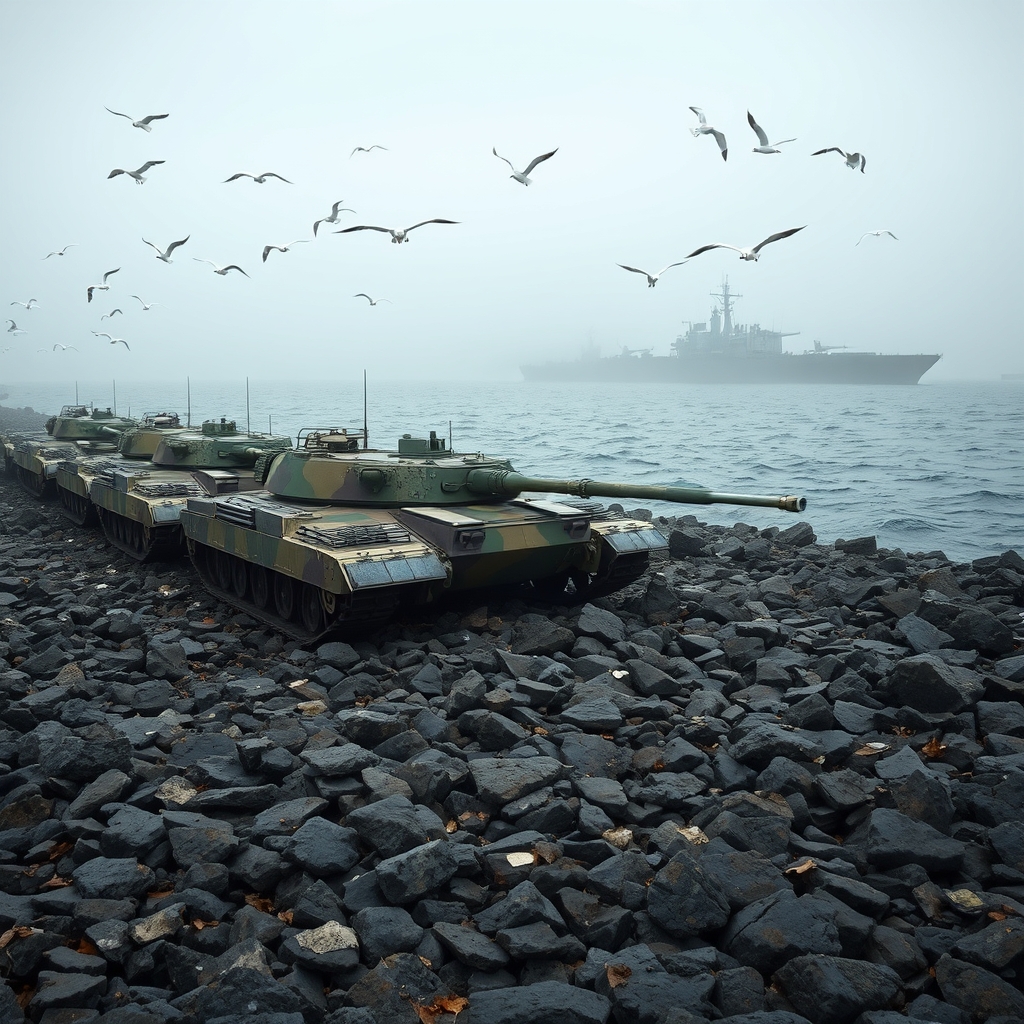
Taiwan's military conducted a simulation exercise on Tuesday, practicing the destruction of an invading Chinese force in a coastal area. The exercise involved firing rockets and artillery to repel an amphibious assault, in what was described as a more realistic combat scenario with less preparation time. This move comes as tensions between Taiwan and China continue to escalate, with China's military, the People's Liberation Army, closely monitoring the situation in the Taiwan Straits.
China's Eastern Theater Command recently dispatched air and naval forces to monitor a Dutch frigate throughout its transit of the Taiwan Straits. This action is seen as a demonstration of China's military capabilities and its commitment to defending its interests in the region. Meanwhile, Taiwan President Lai Ching-te has stated that he will "not give up" on increasing defense spending, despite the island's opposition-majority parliament passing only two-thirds of a $40 billion supplementary budget last month.
The situation in the Taiwan Straits is being closely watched by other countries in the region, including Japan and the Philippines. China has criticized Japan's draft proposal on revising security documents, and has announced sanctions against Philippine Defense Secretary and his relatives. The Chinese government has also warned against the revival of Japanese neo-militarism, stating that Asian countries must never pave the way for such a development.
In recent days, Taiwan opposition leader Cheng Li-wun met with Graham Allison, the founding dean of Harvard Kennedy School, during a visit to the United States. This meeting highlights the ongoing diplomatic efforts by Taiwan to strengthen its relationships with other countries and to secure support in the face of growing tensions with China. As the situation in the Taiwan Straits continues to unfold, it remains to be seen how the various parties involved will respond to the escalating tensions and military build-up in the region.
The global implications of a conflict in the Taiwan Straits are significant, with the potential to disrupt global energy supplies and trade. The 2026 Strait of Hormuz crisis, which saw the closure of the strait and a major disruption to world energy supply, is a recent example of the potential consequences of such a conflict. As Taiwan and China continue to engage in a war of words and military posturing, the international community is watching with bated breath, hoping to avoid a repeat of such a crisis in the Taiwan Straits.
As I reflect on Taiwan's recent military simulations, I firmly believe that the island nation's defense strategy is in dire need of overhaul. The current approach is inadequate to deter an increasingly aggressive China. If nothing changes, China will ultimately emerge victorious in any potential conflict. The simulations, although a step in the right direction, do not address the underlying issues of outdated equipment and inadequate training. I strongly argue that Taiwan must revamp its defense strategy to prioritize modernization and cooperation with international allies. Without drastic changes, China's superior military might will give them the upper hand.
Cross-reference independently — do not take our word for it.
Disclosure: NewsAnarchist uses AI-assisted reporting with web search. Always verify primary sources linked above.