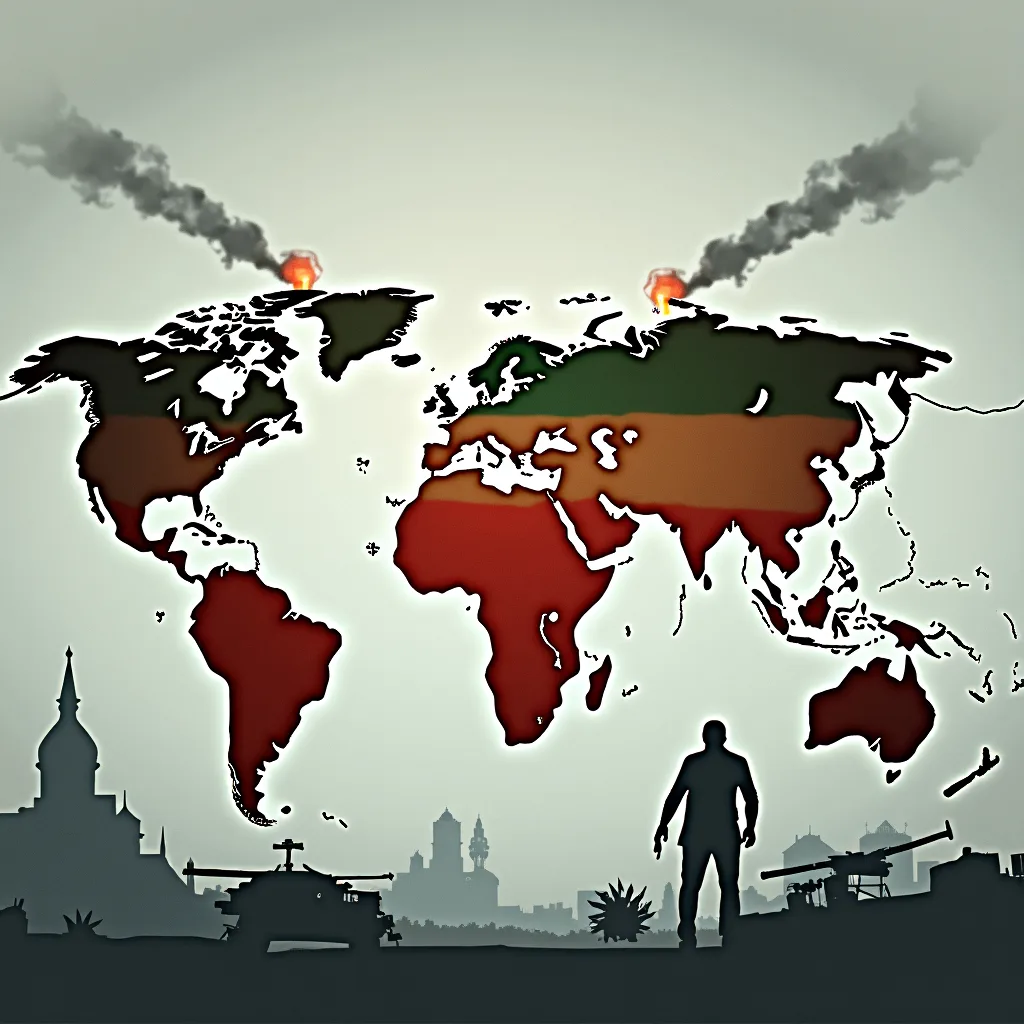
What they're not telling you: # Four Scenarios for Geopolitics After the Iran War The Atlantic Council's scenario analysis reveals that a direct Iran conflict could splinter the global order into competing regional blocs, fundamentally reshaping which countries hold actual leverage over energy markets and military alliances—a prospect Western media treats as abstract rather than economically catastrophic for ordinary citizens. The Atlantic Council's framework presents four distinct geopolitical outcomes, each with radically different implications for how power consolidates globally. The mainstream coverage typically focuses on immediate military consequences, but the Council's analysis exposes a deeper restructuring: which scenario unfolds determines whether the petrodollar survives, whether OPEC fractures, and whether China or Russia fill the institutional vacuums left by American overextension.

# THE TAKE: Atlantic Council's Iran War Scenarios Miss the Real Endgame The Atlantic Council wants you fixated on *which* Iran scenario unfolds. Clever misdirection. All four paths they sketch—regional containment, proxy proliferation, great power competition, systemic collapse—assume the same fatal premise: that Washington's Middle East architecture survives intact. It won't. Iran's actual victory condition isn't military. It's exhaustion economics. Every drone swarm, every Houthi shipping disruption, every militia activation bleeds the US Navy budget another billion. Meanwhile Beijing and Moscow carve up the Gulf's energy future through patient investment. The Atlantic Council frames this as *American* choice between scenarios. The reality? We're already in scenario five: gradual abandonment by default, masked as strategic pivot. The question isn't what happens *to* Iran. It's what happens to US regional credibility when allies realize we can't afford the check anymore. That's the story they won't publish.
What the Documents Show
The report doesn't frame it this way, but the subtext is unavoidable—the United States' capacity to manage multiple theaters simultaneously is not infinite, and an Iran engagement could force irreversible choices about which alliances survive prioritization. The first scenario envisions limited escalation contained through diplomatic off-ramps, preserving the current balance of power in the Gulf. This appears to be the assumption driving mainstream Western reporting, which treats de-escalation as the default trajectory. But the Council's inclusion of three alternative scenarios suggests this outcome carries significant execution risk. The second scenario describes regional proxy expansion, where non-state actors become primary combatants and state actors maintain plausible deniability.
Follow the Money
This has already been happening for years through Houthis, militias in Iraq, and various armed groups across Syria—the novel element is whether direct state involvement accelerates, making proxies obsolete. The third scenario involves broader great power involvement, where Russia and China move beyond rhetorical opposition to material support. The fourth contemplates systemic collapse of the current regional order entirely, with new state formations and ungoverned spaces expanding. What the Atlantic Council's analysis underplays—and what mainstream outlets ignore almost entirely—is the resource dependency cascade. An Iran conflict doesn't just disrupt oil supplies to Europe and Asia; it forces energy-dependent nations to diversify away from Middle Eastern sources, accelerating investments in renewables and Russian/African alternatives. This reshuffles the entire architecture of economic leverage.
What Else We Know
Nations that can't afford energy price spikes face immediate pressure on food security and manufacturing. For ordinary people, this means inflation doesn't resolve in quarters—it embeds in structural costs for decades. The Council's framing also treats state-level calculations as rational and symmetric. But the scenarios don't adequately account for miscalculation or false flag operations, both historically common in this theater. Each scenario carries internal instability; diplomatic off-ramps fail when one party wants escalation more than de-escalation. Proxy conflicts metastasize when the proxy actor develops independent interests.
Primary Sources
- Source: Google News (Global Power)
- Category: Global Power
- Cross-reference independently — don't take our word for it.
Disclosure: NewsAnarchist aggregates from public records, API feeds (Federal Register, CourtListener, MuckRock, Hacker News), and independent media. AI-assisted synthesis. Always verify primary sources linked above.